
Commercial Pool Renovation for Aging and Underperforming Pools Across Pinellas County
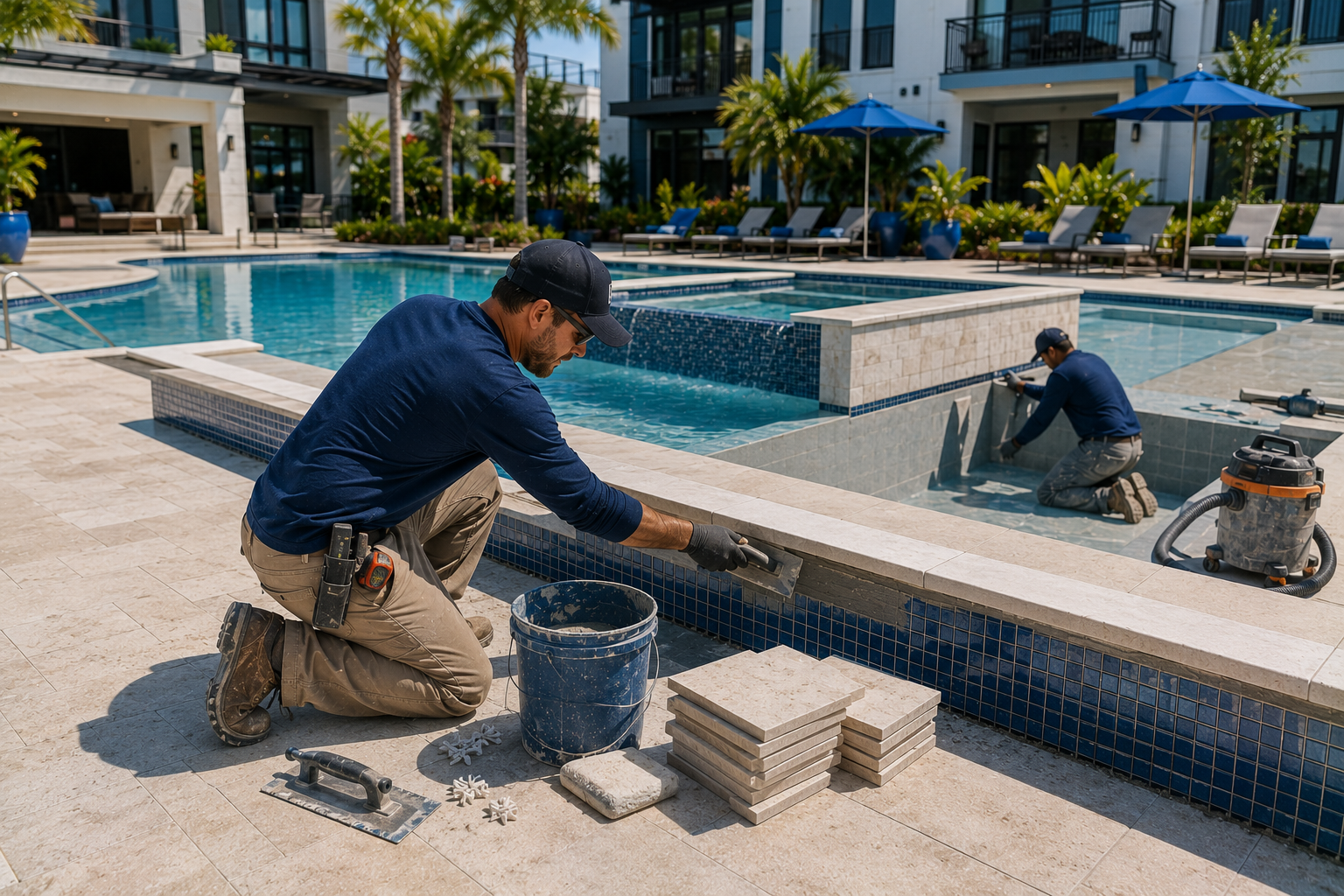
Commercial pool renovation is not a cosmetic decision—it’s an operational one.
At a certain point, ongoing maintenance and equipment repair stop solving the problem. The pool becomes harder to balance, more expensive to operate, and more sensitive to usage, weather, and demand. When multiple systems start working against each other, the issue is no longer maintenance—it’s the condition and configuration of the pool itself.
Renovation is how that condition gets corrected.
For HOAs, apartments, hotels, and shared-use facilities, the goal of commercial pool renovation is not to “update” the pool. It’s to bring the system back into a state where water can be stabilized, equipment can operate efficiently, and the pool can handle real usage without constant intervention.
If your pool is becoming more difficult to manage year over year, you can discuss a commercial pool renovation plan to determine whether the issue is structural, mechanical, or both.
When Ongoing Maintenance Stops Being Enough
Pools don’t typically go from stable to unusable overnight. What happens instead is gradual loss of control.
You may notice:

Water takes longer to clear after use

Chemical levels don’t hold like they used to

Algae returns faster, even with consistent service

Equipment runs longer to achieve the same results

Surfaces feel rough or show persistent staining

Complaints increase despite regular upkeep
These are not isolated issues. They are indicators that the pool system—surface, hydraulics, equipment, and usage demand—is no longer aligned.
At that point, increasing commercial pool maintenance frequency may temporarily help, but it usually does not solve the underlying problem. Renovation becomes the more effective path because it addresses the cause instead of the symptoms.
Renovation Is About Resetting System Behavior
Every commercial pool has a baseline condition where it operates predictably. Over time, that baseline shifts.
Renovation is the process of resetting that baseline.
This may involve:
- Restoring a surface that no longer supports sanitation
- Correcting flow patterns that limit circulation
- Updating equipment that cannot keep up with demand
- Reconfiguring plumbing or returns to improve distribution
- Aligning system components so they work together again
Surface Condition Is Often the Hidden Driver
Many renovation projects are triggered by what appears to be a surface issue—but the impact goes deeper than appearance.
As surfaces age, they change how the pool behaves:
- Porous finishes hold contaminants longer
- Biofilm and algae attach more easily
- Brushing becomes less effective
- Chemical demand increases to maintain sanitation
- Staining becomes harder to remove
Flow and Circulation Problems Are Often Built Into the System
Many commercial pools operate with circulation patterns that were never optimized—or no longer match how the pool is used.
Over time, this creates:
- Dead zones where water doesn’t move effectively
- Uneven chemical distribution
- Areas that require more frequent cleaning
- Persistent localized water quality issues
These problems cannot be fixed with chemicals or cleaning alone.
During renovation, circulation can be corrected by:
- Adjusting return placement
- Modifying plumbing configurations
- Matching pump output to system demand
- Improving how water moves through the pool
This directly affects how well the pool can be maintained long-term.
Equipment Upgrades Only Work If the System Is Aligned
Replacing equipment without addressing system conditions is one of the most common mistakes in commercial pools.
A new pump, filter, or heater may improve performance temporarily—but if the underlying system is still misaligned, the same issues return.
Renovation provides the opportunity to evaluate:
Whether equipment is properly sized
Whether flow rates match actual usage
Whether filtration capacity is sufficient
Whether controls & automation are integrated correctly
If your facility has relied heavily on commercial pool equipment repair, that often indicates the system needs more than replacement parts—it needs alignment.
Partial Renovation vs Full Renovation Is a Strategic Decision
Not every commercial pool requires a full renovation.
In some cases, targeted updates—such as resurfacing, plumbing adjustments, or equipment replacement—can restore stability.
In other cases, partial renovation creates new problems by improving one area while leaving others unchanged.
For example:
- Resurfacing without addressing circulation can leave water quality issues unresolved
- Upgrading equipment without correcting flow limitations can reduce efficiency gains
- Improving filtration without addressing debris load or usage patterns can create imbalance
The decision between partial and full renovation should be based on how the system performs—not just budget or visible condition.
Renovation Has to Account for How the Pool Is Actually Used
Commercial pools are not static environments.
Usage varies based on:
- Property type
- Occupancy levels
- Time of year
- Daily peak demand
- Environmental exposure
This is why renovation planning should consider:
- Real bather load, not assumed usage
- Peak demand periods
- Maintenance access and workflow
- Safety and compliance requirements
- Long-term operating cost
Downtime and Phasing Matter in Commercial Renovation
Unlike residential pools, commercial properties often have operational constraints.
Closing a pool affects:
- Residents
- Guests
- Members
- Revenue
- Property perception
- Project timing
- Scope sequencing
- Whether work can be phased
- How long the pool will be offline
- What needs to be completed at once vs staged
Why Curtis Pools
70+ Years of Experience
We’ve seen how commercial pools change over time and how small inefficiencies evolve into system-wide issues that require renovation—not just repair.
Complimentary Design & Planning
We evaluate surface condition, circulation, equipment, and usage patterns together to determine what actually needs to be addressed.
Exclusive Free Start-Up Package
After renovation, we help establish a stable operating baseline so the system performs correctly from day one.
Locally Trusted Across the Region
Experience across Largo and surrounding areas provides practical understanding of environmental exposure, usage patterns, and long-term wear.
Waterfront & Structural Specialists
We account for site-specific factors like soil conditions, drainage, and exposure that influence long-term performance.
Unmatched Craftsmanship & Customization
Renovation strategies are built around how the pool operates—not applied as a standard package.
In-House Team, No Shortcuts
Design, renovation, and system alignment are handled cohesively, reducing the disconnect that often leads to repeat problems.
Areas We Serve
Curtis Pools provides commercial pool renovation and related services across:
Frequently Asked Questions