Commercial Pool Equipment Repair for Largo-Area Facilities and Property Operators
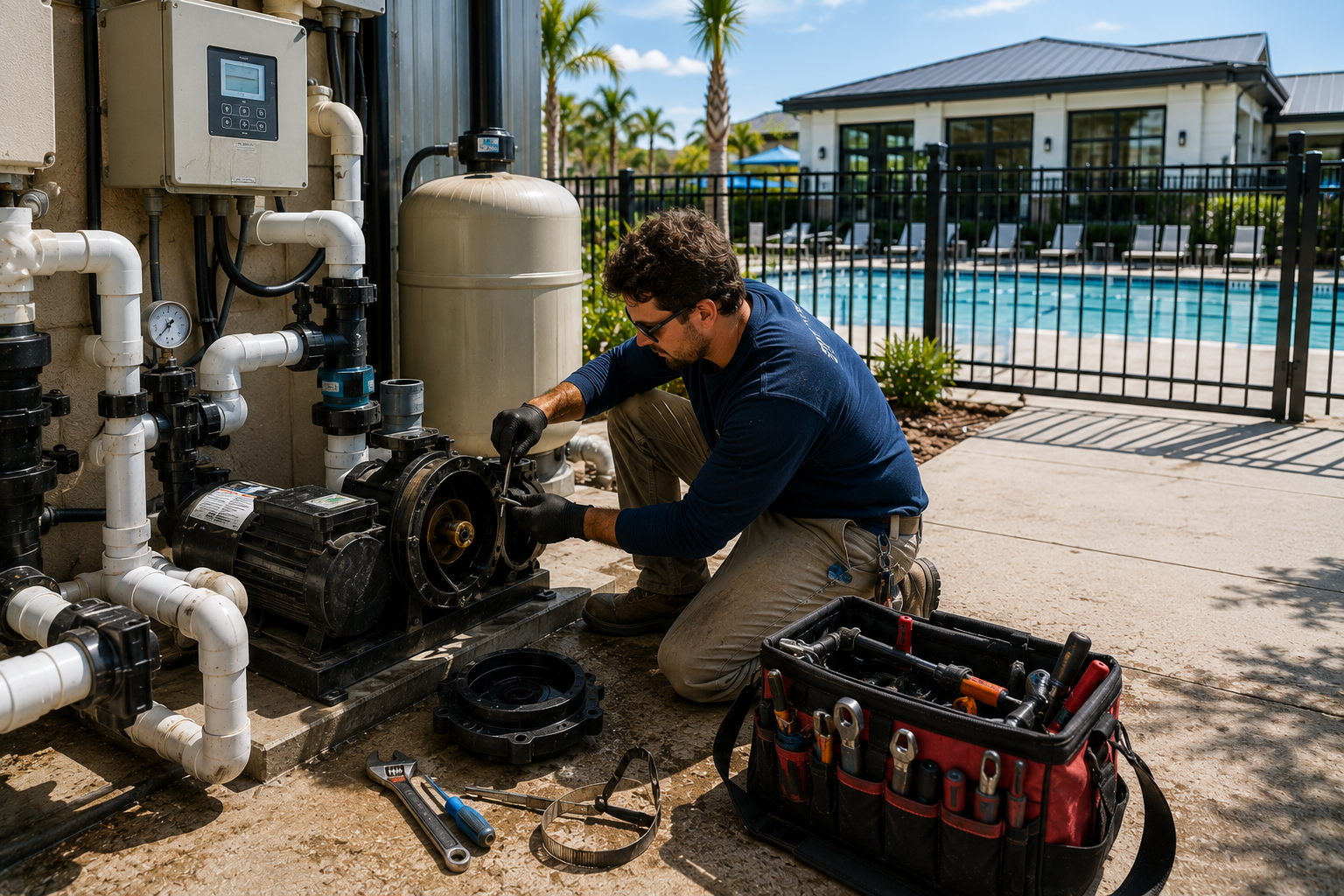
Commercial pool equipment repair requires more than swapping out a failing part. In a commercial pool, pumps, filters, heaters, valves, sensors, automation controls, and chemical feeders all work together. When one piece underperforms, the entire system can become harder to manage.
For hotels, HOAs, apartment communities, fitness centers, and shared-use facilities, equipment problems can affect water clarity, chemical stability, inspection readiness, guest complaints, and operating costs. A pump that still “turns on” may not be moving enough water. A heater that still fires may be wasting energy. An automation system that still displays readings may be dosing incorrectly.
If your system is showing signs of inconsistent flow, rising chemical demand, heater trouble, repeated alarms, or recurring water quality problems, you can schedule commercial pool equipment repair before a manageable issue turns into a facility-wide problem.
Equipment Problems Usually Start Before the Failure
Most commercial pool equipment issues begin as performance loss, not total failure.
A pump may lose efficiency before it stops working. A filter may struggle before water turns cloudy. A heater may cycle inconsistently before it fails completely. Automation may begin producing unreliable readings before anyone realizes the system is making bad decisions.
Early warning signs often include:
- Lower flow at returns
- Higher filter pressure
- Longer pump run times
- Chemical readings that swing more than usual
- Heater delays or inconsistent temperature
- Controller alerts, sensor errors, or dosing irregularities
- Water clarity issues that keep returning after correction
These signs matter because commercial pools do not have much room for error. Heavy use, tight operating schedules, and inspection requirements make delayed equipment repair more expensive than it may appear at first.
Commercial Pool Equipment Repair Starts With Diagnosis
A good repair process starts with identifying why the equipment is failing—not just which part is failing.
If a pump burns out, the question is not only whether the motor needs replacement. The better question is what caused the strain. Was the pump oversized, undersized, starved for water, dealing with excessive head pressure, or operating against a dirty filter? If a heater keeps shutting down, the issue may be flow, sensors, scale buildup, gas supply, electrical components, or control integration.
Commercial pool equipment repair should evaluate:
- Flow and pressure behavior
- Equipment age and efficiency
- Electrical and control issues
- Plumbing restrictions
- Filter condition
- Automation communication
- Whether the equipment is properly matched to the pool’s demand
Without that level of diagnosis, repairs can become temporary. The same issue returns because the underlying cause was never corrected.
Pump and Motor Repairs Affect the Entire Pool
Pumps are the movement system for the pool. When pump performance drops, every other part of the system has to compensate.
A weak or failing pump can cause:
- Poor circulation
- Reduced filtration turnover
- Uneven sanitizer distribution
- Cloudy water
- Increased chemical use
- Extra strain on heaters and feeders
Common pump and motor issues include seal failure, bearing wear, impeller problems, air leaks, electrical faults, overheating, and motor degradation from continuous operation. In some cases, the pump can be repaired. In others, replacement may be the better decision if efficiency has declined or the equipment is no longer properly matched to the facility.
This is where equipment repair connects directly to commercial pool maintenance. If maintenance records show recurring flow problems, frequent filter cleaning, or repeated motor issues, the repair decision should account for the entire pattern—not just the current service call.
Filter Problems Can Look Like Water Chemistry Problems
Filtration issues are often misread as chemical problems.
When filters are not performing correctly, contaminants remain in the water longer than they should. The result may look like poor chemical management, but the root cause may be mechanical.
Filter-related issues can include:
- High pressure
- Channeling in media
- Damaged grids or cartridges
- Inadequate backwashing
- Internal wear
- Incorrect filter sizing
- Flow restrictions caused by upstream equipment problems
Heater Repair Requires More Than Checking Temperature
Commercial pool heaters fail for multiple reasons, and temperature inconsistency is only one symptom.
A heater may struggle because of:
- Low or inconsistent flow
- Scale buildup
- Sensor failure
- Ignition issues
- Heat exchanger problems
- Gas or electrical supply issues
- Control system conflicts
Automation and Control Failures Can Be Hard to Spot
Automation problems are not always obvious because the system may still appear to be operating.
A controller can display readings, trigger schedules, and activate equipment while still producing inconsistent results. Sensor drift, communication errors, programming issues, actuator failures, or dosing problems can create instability that looks like a water chemistry issue.
Common automation-related problems include:
- Incorrect chemical dosing
- Pump schedules not matching usage
- Heater schedules not coordinating with demand
- Sensor readings that do not match manual tests
- Valves or actuators failing to respond
- Alerts that are ignored or misinterpreted
Repair vs Replacement Is an Operating Cost Decision
Not every piece of equipment should be repaired indefinitely.
A repair may make sense when the equipment is still efficient, parts are available, and the failure is isolated. Replacement may make more sense when repairs are recurring, energy use is increasing, or the equipment no longer fits the system’s actual demand.
The decision should account for:
- Age of the equipment
- Frequency of repairs
- Energy consumption
- Parts availability
- Compatibility with automation
- Impact on water quality
- Risk of downtime
Delayed Equipment Repair Creates Bigger Problems
Waiting too long to repair commercial pool equipment can create a chain reaction.
A weak pump can reduce filtration. Reduced filtration can increase chemical demand. Higher chemical demand can make water harder to stabilize. Poor stability can increase cleaning needs, resident complaints, or inspection risk.
Delayed repair can lead to:
- Higher utility costs
- More chemical use
- Shorter equipment lifespan
- Increased emergency repair risk
- Water clarity problems
- Facility downtime
When Equipment Issues Point to a Bigger System Problem
Sometimes equipment repair is only one part of the solution.
If equipment keeps failing, the issue may be caused by:
- Poor original sizing
- Bad plumbing layout
- High head pressure
- Outdated automation
- Surface deterioration increasing demand
Common Commercial Pool Equipment Repair Mistakes

Replacing Parts Without Testing the System
A new component can fail early if the underlying pressure, flow, or electrical issue remains.

Ignoring Efficiency Loss
Equipment that still runs may be costing too much to operate or failing to support water quality.

Treating Automation as Always Correct
Controllers and sensors need verification. Automated readings should be compared against actual system behavior.

Repairing Equipment Without Reviewing Maintenance History
Recurring failures usually tell a story. Ignoring that pattern leads to repeat service calls.

Waiting Until the Pool Is Unusable
The best time to repair commercial pool equipment is when symptoms first appear—not after the system has already caused downtime.
Why Curtis Pools
70+ Years of Experience
We understand how commercial pool equipment behaves under constant use, including the difference between a simple part failure and a system issue that will keep coming back.
Complimentary Design & Planning
We evaluate equipment problems in context, looking at flow, filtration, controls, usage demand, and repair history before recommending a direction.
Exclusive Free Start-Up Package
After repair or system adjustment, we help establish a stable operating baseline so equipment performance, chemistry, and circulation are working together.
Locally Trusted Across the Region
Experience across Largo, Pinellas County, and nearby service areas gives us practical familiarity with usage patterns, coastal conditions, and environmental strain on equipment.
Waterfront & Structural Specialists
We account for site conditions that affect equipment reliability, including exposure, drainage, runoff, groundwater concerns, and system load.
Unmatched Craftsmanship & Customization
Repair recommendations are based on the actual equipment setup, not a generic fix. Pumps, filters, heaters, valves, automation, and plumbing all have to work as one system.
In-House Team, No Shortcuts
Repair, maintenance, cleaning, and system evaluation are handled with accountability, reducing the disconnect that often causes repeat equipment failures.
Areas We Serve
Frequently Asked Questions