Commercial Pool Maintenance That Keeps High-Use Pools Stable Across Pinellas County
Commercial pool maintenance is what determines whether a pool runs predictably or constantly needs intervention. Cleaning handles what you can see, but pool maintenance controls the underlying systems—circulation, filtration, chemistry, and equipment—that keep the water stable under continuous use.
In commercial environments, instability doesn’t show up gradually. A pool can operate normally for weeks, then suddenly shift into recurring issues—cloudy water, chemical swings, equipment strain, or failed inspections. When that happens, it’s rarely caused by a single event. It’s the result of commercial pool maintenance that is not aligned with how the pool is actually being used.
If your pool requires frequent chemical corrections, inconsistent equipment performance, or repeated service calls, the issue is not effort—it’s system alignment. You can get a commercial pool maintenance assessment to determine where your current setup is breaking down.
Why Commercial Pool Maintenance Problems Don’t Stay Isolated
In commercial pools, no issue exists on its own.
A minor imbalance—slightly reduced circulation, a partially clogged filter, or inconsistent chemical dosing—affects the entire system. Over time, these small inefficiencies compound and increase overall pool maintenance demand.
What starts as:
Slightly elevated chlorine demand Becomes:
- Increased chemical cost
- More frequent adjustments
- Reduced clarity
- Higher equipment runtime
Which then leads to:
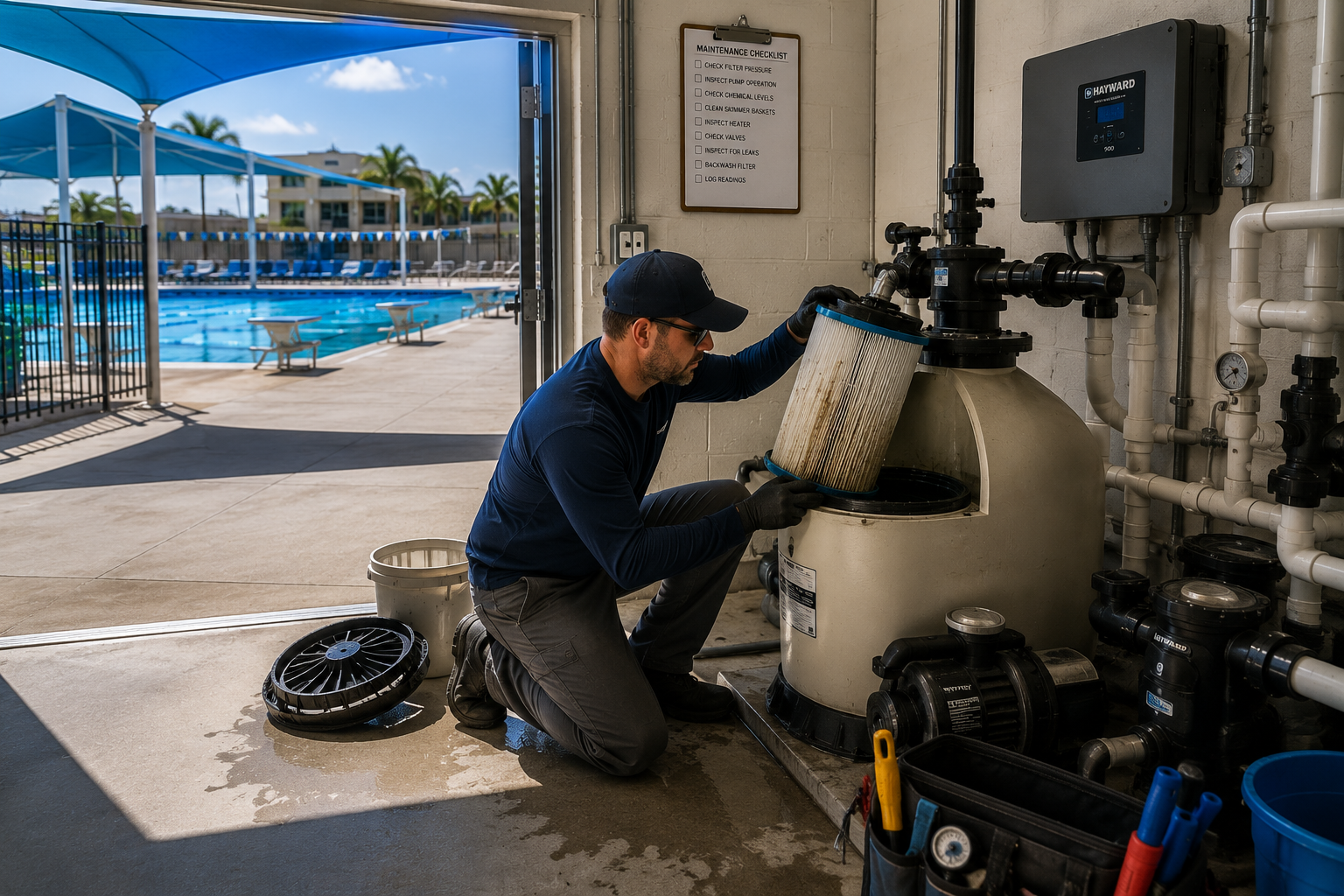
- Pump strain
- Filter overload
- Heater inefficiency
- Inconsistent sanitation
This is why commercial pool maintenance must be preventative, not reactive. Once the system starts drifting, every correction becomes less effective and more expensive.
Commercial Pool Maintenance Controls System Interdependence
Commercial pools operate as interconnected systems, not independent components.
Commercial pool maintenance must continuously manage the relationship between:
- Chemical balance and circulation
- Circulation and filtration
- Filtration and debris load
- Surface condition and sanitation efficiency
- Equipment performance and energy consumption
If one component changes, it alters the behavior of the entire system.
For example:
- Reduced flow lowers sanitizer distribution
- Poor filtration increases organic load
- Increased organic load raises chlorine demand
- Higher chlorine demand increases operational cost
This is why commercial pool maintenance must stay coordinated with commercial pool cleaning services and commercial pool equipment repair services. Treating them separately creates blind spots where problems develop.
Chemical Stability Is a Moving Target, Not a Fixed Setting
One of the most common failures in commercial pool maintenance is treating chemical balance as something that can be “set.” In reality, chemical demand changes constantly based on:
- Bather load fluctuations
- Circulation consistency
- Organic contamination (oils, sunscreen, debris)
- Weather shifts (rainfall, temperature, UV exposure)
- Filtration performance
A pool that is perfectly balanced in the morning can drift out of range by the afternoon if usage spikes.
This is why commercial pool maintenance must include:
- Frequent testing and adjustment
- Understanding cause vs symptom
- Anticipating demand changes rather than reacting to them
Even with smart pool automation systems, chemical control still requires oversight. Automation maintains patterns—it does not diagnose underlying problems within your pool maintenance system.
Equipment Maintenance Is About Efficiency, Not Just Function
Commercial pool equipment rarely fails immediately. It loses efficiency first.
That loss of efficiency shows up as:
- Longer pump run times
- Reduced flow rates
- Increased filter pressure
- Inconsistent heating
- Higher energy usage
If ignored, they lead to:
- System imbalance
- Water quality issues
- Premature equipment failure
- Increased operational cost
Filtration and Circulation Drift Over Time
Filtration systems do not operate at a constant level indefinitely.
As conditions change:
- Filters load with debris
- Plumbing develops resistance
- Flow rates shift
- Return patterns become uneven
The result is:
- Slower contaminant removal
- Uneven chemical distribution
- Increased reliance on chemical correction
- Monitoring pressure differentials
- Adjusting cleaning cycles
- Verifying flow consistency
- Identifying circulation dead zones
Surface Condition Impacts Maintenance Load
Pool surfaces play a larger role in maintenance than most operators realize.
As surfaces age:
- They become more porous
- Algae adheres more easily
- Staining becomes more frequent
- Brushing becomes less effective
When Commercial Pool Maintenance Needs to Change
Maintenance plans often remain static—even when conditions don’t.
A plan that worked previously may no longer be effective if:
- Usage has increased
- Facility type has changed
- Equipment is aging
- Environmental exposure has shifted
- Water issues are recurring
Common Commercial Pool Maintenance Failures

Reactive Maintenance Instead of Preventative Control
Adjustments are made after issues appear instead of preventing them.

Misdiagnosing Chemical Issues
Symptoms are treated without identifying root causes like circulation or filtration problems.

Ignoring Gradual Equipment Changes
Efficiency losses are overlooked until performance drops significantly.

Static Maintenance Plans
Service schedules do not adapt to changing usage or conditions.

Disconnect Between Cleaning and Maintenance
Cleaning and pool maintenance operate independently instead of as a coordinated system.
These failures increase cost, reduce reliability, and create ongoing operational issues.
Why Curtis Pools
70+ Years of Experience
Complimentary Design & Planning
We evaluate your entire system—not just surface symptoms—to determine where commercial pool maintenance is breaking down and why.
Exclusive Free Start-Up Package
We establish a stable baseline for chemical balance, circulation, and equipment performance so maintenance starts from the correct position.
Locally Trusted Across the Region
Experience across Largo and surrounding service areas provides insight into environmental and usage factors that directly impact pool maintenance needs.
Waterfront & Structural Specialists
We account for external conditions like runoff, soil movement, and exposure that influence long-term system stability.
Unmatched Craftsmanship & Customization
Maintenance strategies are tailored to system design, usage patterns, and equipment—not applied generically.
In-House Team, No Shortcuts
Cleaning, maintenance, and repair are coordinated to maintain consistency across the entire system.
Areas We Serve
Frequently Asked Questions